
Humanitarian Principles
The core principles of humanity, impartiality, neutrality, and independence are cornerstones of effective humanitarian programming, defining and clarifying the humanitarian mission. In an era of increasingly complex crises and waning multilateralism, these principles have become more critical than ever.
Humanitarian actors often assert that they deliver their actions in accordance with these principles, but we believe the mere statement is not enough. What evidence can they provide that they do follow the principles? Can the degree to which they apply the principles be assessed? And how best to safeguard principled humanitarian action?
We have developed methods to review the application of the four core principles. Looking through this lens at a number of different contexts – from Iraq to Ukraine, via Yemen, Ethiopia, and Sudan – our reports and evaluations have continuously seen how a principled approach requires transparent communication and collective reflection around necessary compromises.
A review of principled humanitarian response in Ukraine: Principled Compromises or Compromised Principles?
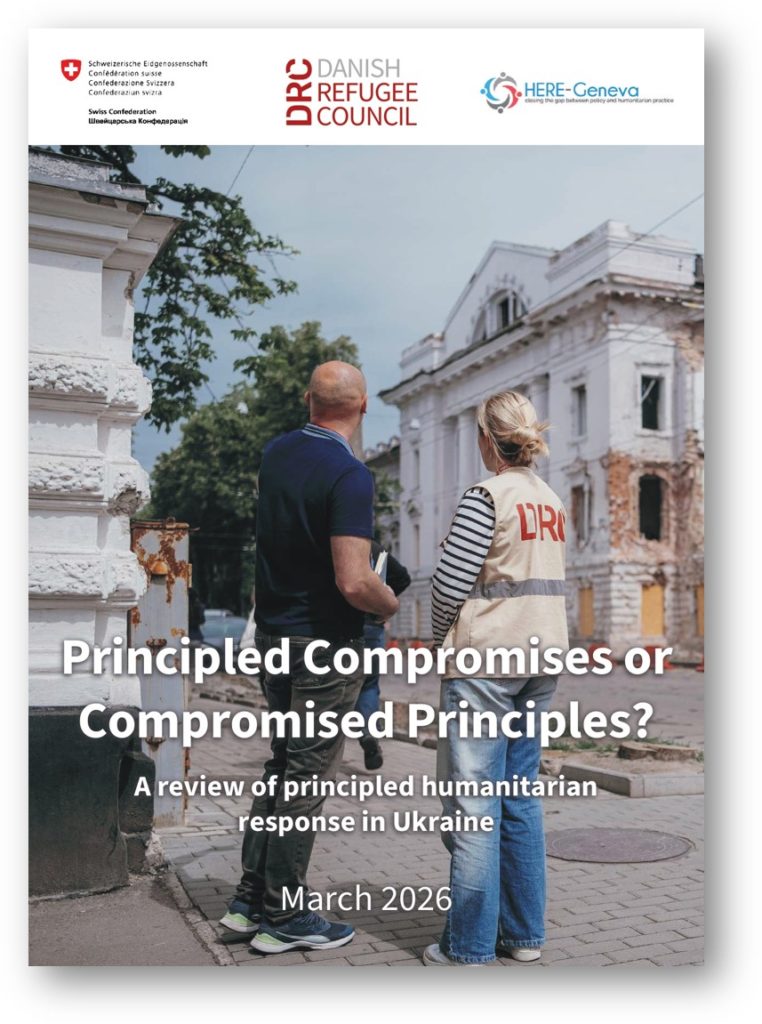
This report describes the extent to which the four core principles that underpin humanitarian action have been applied in and are relevant to the ongoing response to people in need in Ukraine. If humanitarians expect armed forces to respect their mandates and mission, they must be clear on their own agendas, intentions, and objectives. However, in Ukraine, the lines between who is humanitarian and who is not have been blurred. Since the large-scale invasion in February 2022, a range of countries have supported Ukraine with a large aid package, of which humanitarian aid is only a small part. Moreover, organisations providing aid have for various reasons refrained (often inadvertently) from establishing a clear distinction between their humanitarian work and other types of assistance. Essentially, humanitarians can do better in safeguarding their mission and explaining what makes their work humanitarian.
The humanitarian principles are intended precisely to help navigate highly politicised environments, like Ukraine, to address access restrictions and to guide complex relationships. Clearly, such an approach implicates the role of leadership. Importantly, the key factor in assessing the principledness of a response is not necessarily the ‘what’ organisations do, but whether and how agencies have addressed the principles in setting priorities, taking decisions, and managing compromise. The delivery of humanitarian aid in complex environments is by nature a balancing act between often competing priorities, and there is no such thing as a fully principled approach. “Principled compromises” are called for, however, rather than “compromised principles.”
Lost in Sudanisation? What it means to apply a principled humanitarian approach in the response to the crisis in Sudan
April 2025. The key to a more effective collective principled approach is not making everyone do the same thing. On the contrary, it is about recognising the added value and specific strengths of each actor and understanding how to achieve complementarity among their different approaches.
In Sudan, we saw that a deeper collective dialogue on the definition of principled humanitarian action was however missing. Instead of a reactive debate focusing on red lines, organisations should focus strategically on a framework for principled decision making, that does not preclude the exploration of diverse strategies. Actors across Sudanese civil society play a vital role and their contributions should be recognised and enhanced as part of a more inclusive humanitarian strategy that preserves their identity, added value, and flexibility.
Ultimately, the responsibility lies with individual actors to assess whether alternative approaches align with their mandates and values, and with the collective to openly discuss and agree upon a common strategy. Importantly, the humanitarian principles should not be viewed as an ethical stumbling block but as part of a framework to help agencies weigh their decisions.
Inter-Agency Humanitarian Evaluation of the Response to the Crisis in Northern Ethiopia
June 2024. The application of the humanitarian principles in the response to the war in Northern Ethiopia between November 2022 and November 2022 permeate the Inter-Agency Humanitarian Evaluation of the collective response to this crisis..
The conflict in Northern Ethiopia saw extreme levels of violence against civilians and grave, systematic violations of international law, creating a context where the UN had very little room to respond effectively. That said, the UN-led humanitarian response was embedded in a principled humanitarian framework. While the Humanitarian Country Team had agreed on joint operating principles (JOP) this framework was never applied. In addition, access negotiations were not framed within international humanitarian law. Strong disagreements within the HCT on what approach to take vis-à-vis the Federal Government rendered it dysfunctional.
Principled Humanitarian Programming in Yemen: A ‘Prisoner’s Dilemma’?
December 2021. This review found that a lack of trust and communication about how each actor operationalised the principles in Yemen hindered the effectiveness of the response. Whether implicitly or explicitly, principles were an everyday reference for all humanitarian actors in the country, and a coordinated principled approach was considered by most as the best way to reach the people most in need with good quality assistance and protection. Still, organisations tended to navigate the context from their own individual perspective, and without consideration of the way their decisions impacted the principled humanitarian programming of others, or in the future.
We noted a tendency for different stakeholders to consider their own approach to the humanitarian principles as sacrosanct. Too polarised a discussion around the principles is detrimental to a successful collective approach to principled programming. The recognition of possible nuances allows for a reflection on what type of compromises may be necessary, and what safeguards may consequently be needed.
Recognising that the members of the humanitarian community will in the long run be better off by communicating with each other around their choices, and coordinating their approaches as much as possible is key. More meaningful and strategic exchanges around how to approach the context in Yemen in a principled manner would improve the collective leverage of the humanitarian community, and could ultimately make humanitarian action more effective for people in need.
Principled Humanitarian Assistance of ECHO Partners in Iraq
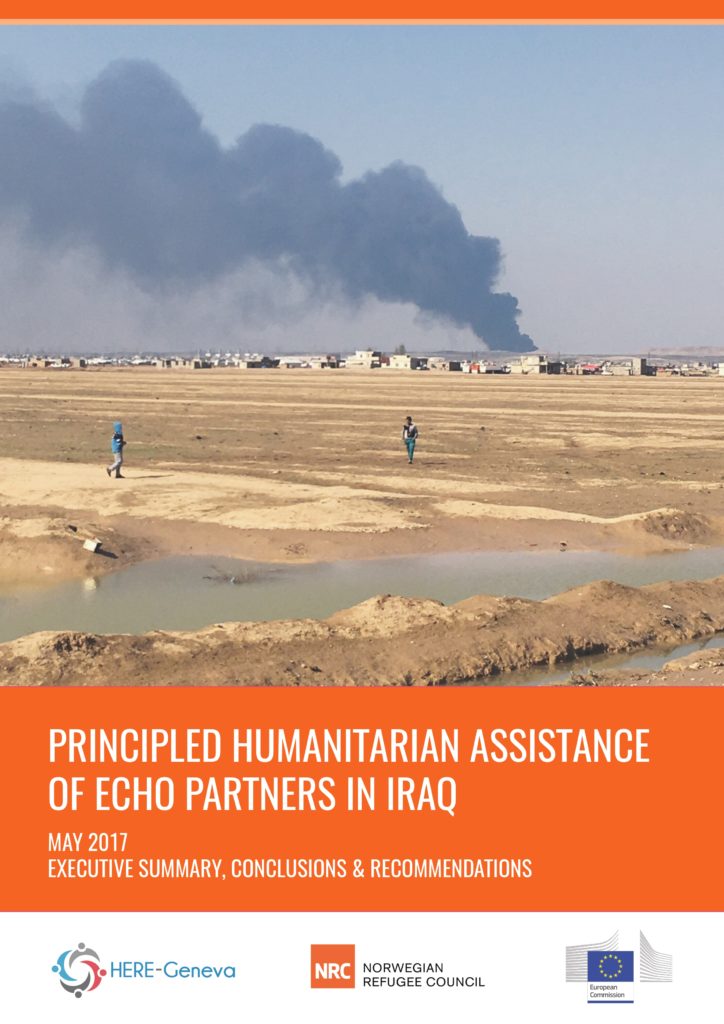
May 2017. Reviewing the application of the humanitarian principles of humanity, impartiality, neutrality, and independence in Iraq, we saw that they were invoked inconsistently, and often to justify opposing courses of action in the same context. While all partners referenced the principles, their operational translation varied widely, undermining a collective humanitarian identity.
Key concerns included a pronounced risk aversion that leads organisations to avoid areas labelled ‘hard to reach’—often where needs may be greatest—and an over-reliance on UN-led civil-military coordination rather than investing in their own capacity to negotiate access. The review also highlighted insufficient efforts to understand how aid is perceived by local stakeholders and a lack of transparency in how difficult trade-offs between principles are made.
Scrutinising specific dilemmas – the use of armed escorts, engagement in screening and detention sites, and the implications of working alongside military actors – this review concluded that principled humanitarian action requires more than rhetorical commitment; it demands demonstrable accountability in how organisations weigh all four principles, particularly when the ‘humanitarian imperative’ is used to override neutrality or independence.
Walk the Talk: Assessing the application of humanitarian principles on the ground
The first expert panel of ICRC’s Research and Debate Cycle on Principles Guiding Humanitarian Action tackled the topic of the application of the humanitarian principles of humanity, impartiality, neutrality and independence in operational environments. The panel discussed the practical relevance of the principles, the challenges to their application, and the question of whether they should be ‘measured’ or ‘assessed’ so as to best allocate resources and prioritize responses.
Introduction with :
Moderator:
•Helen Durham, Director, Department of International Law and Policy, ICRC
Panelists:
•Marc DuBois, Former Executive Director, Médecins Sans Frontières UK (MSF UK)
•Kate Halff, Executive Secretary, Steering Committee for Humanitarian Response (SCHR)
•Sorcha O’Callaghan, Head of Humanitarian Policy, British Red Cross (BRC)
“Walk the Talk: Assessing the application of humanitarian principles on the ground”
Applying the humanitarian principles: lessons learned from the field
Kate Halff on Measuring the principle of impartiality: challenges and observations
Marc DuBois : What it means to be a principled actor
Sorcha O’Callaghan on Principles and access: the Lebanese Red Cross example
“Walk the Talk: Assessing the application of humanitarian principles on the ground”
• Setting redlines and making good examples contagious
Is there a pragmatic redline when applying the principles?
How to make examples of successful principled action contagious?
“Walk the Talk: Assessing the application of humanitarian principles on the ground”
• Questions and Answers
Is it really possible to assess the application of the humanitarian principles?
Can there be a continuum between development goals and humanitarian principles?
Do principles matter to people in need?
Universal Humanitarian Value and Principles: Accuracy or Fallacy?
On the eve of the WHS Global Consultation, HERE-Geneva organized a public debate to explore the overarching question of whether humanitarian values and principles can reset political agendas.
In a debate moderated by Ambassador Tania Dussey-Cavassini, Mr As Sy (Secretary-General of the International Federation of the Red Cross), Mr Egeland (Secretary-General of the Norwegian Refugee Council), Ambassador Youssef (Assistant Secretary-General of the Organisation of Islamic Cooperation) and Ms. Modeer (State Secretary to the Minister for International Development Cooperation of Sweden) shared their views on the values and principles underpinning humanitarian action.